

our story
For over two centuries, Romanengo has preserved a heritage of craftsmanship built on precious raw materials, passion, and care.

The history of Romanengo began in Genoa in 1780, as a shop specializing in the trade of spices, sugar, and colonial products from distant lands.
Knowledge of the most precious raw materials and a passion for spices, fruits, and flowers accompanied the evolution of the business over time, until it met the art of confectionery, which became its heart.
For over two centuries, through wars, epidemics, and profound social changes, the Romanengo family has preserved and handed down a unique artisanal heritage, becoming a benchmark for sugared almonds, candied fruit, chocolate, and sugar creations.
Our story
-
1780
ARRIVAL IN GENOA

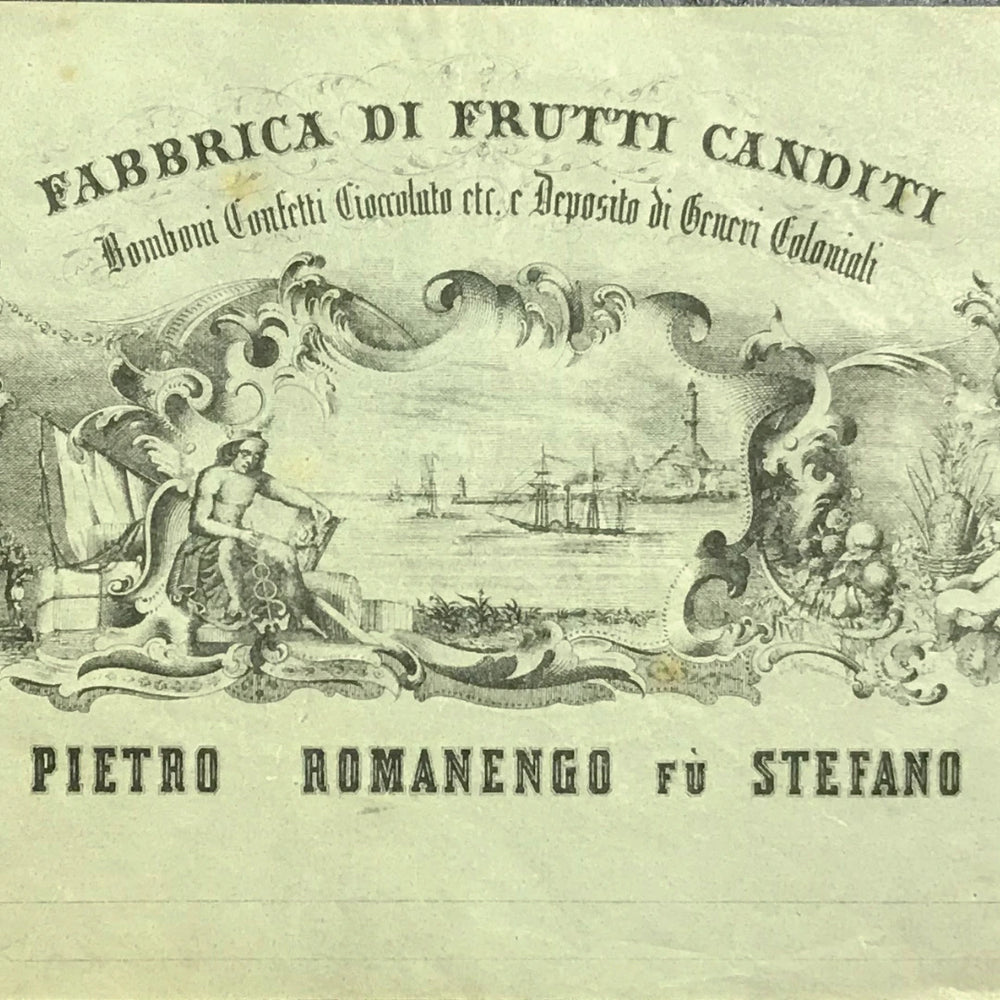
The ancient confectionery "Pietro Romanengo fu Stefano" was founded in Genoa in 1780, when Antonio Maria Romanengo left his native...
The ancient confectionery "Pietro Romanengo fu Stefano" was founded in Genoa in 1780, when Antonio Maria Romanengo left his native Voltaggio, a hilly land along the road to the Po Valley, and moved to Genoa, attracted by the city's flourishing commercial activity and its large port, a crossroads of trade with the world.
Here he started a trade in spices, sugar, and colonial products. His sons Stefano and Francesco would later transform the business, adding the artisanal production of the most refined Genoese confectionery specialties – candied fruit, sugared almonds, and almond paste – to the trade.
The art of confectionery has its roots in ancient exchanges with the East, from which the Genoese learned about sugar and new preservation and processing techniques. According to tradition, the first encounter with sugar dates back to 1099, during the First Crusade, when crusaders and Genoese merchants came into contact with it during the siege of Tripoli in Syria.
Among the ancestors of candied fruit are lemon peels immersed in sugar molasses, a method that allowed for long-term preservation. Also valuable for sailors, they were carried on long sea voyages as a source of vitamin C and to prevent scurvy.
-
1814
THE FIRST SHOP

Romanengo survived the Napoleonic Wars and the difficult blockade of Genoa in 1800 without interrupting its journey.
With the Restoration, Stefano,...
Romanengo survived the Napoleonic Wars and the difficult blockade of Genoa in 1800 without interrupting its journey.
With the Restoration, Stefano, Antonio Maria's son, decided to move the business to the heart of the city, opening a new shop a short distance from the port.
It is the spring of 1814. As the armies of the anti-Napoleonic coalition enter Genoa, contemporary correspondence documents the start of the new business and the desire to create a shop on par with the best confectioneries in Europe.
Stefano Romanengo thus established relationships with Italian and French suppliers, particularly Parisian ones, in search of crystal vases, trays, bonbonnières, and furnishings capable of expressing a contemporary and elegant taste, which he described in his letters as "modern and of better taste."
From its origins, the Romanengo shop has thus distinguished itself through a vision capable of combining artisan tradition, openness to European influences, and a constant search for beauty: values that still define its identity today.
-
1821
THE FIRST FACTORY

A few years after opening the shop in Via Soziglia, Stefano Romanengo rented a new space in Campetto, in the...
A few years after opening the shop in Via Soziglia, Stefano Romanengo rented a new space in Campetto, in the basements of Palazzo Nicolò De Mari. This is where what can be considered Romanengo's first true manufacturing facility was born: a five-story factory, equipped with a large boiler that powered the systems for candying fruit and French machinery for chocolate processing and confectionery.
The new facility represents a fundamental step in the family's history: it marks the beginning of a broader and more structured production organization, capable of complementing the shop with a true artisanal manufacturing facility.
-
1848
Wars and Rebirth

The uprisings of 1848 and subsequent events led to years of uncertainty and instability. With the return of peace, the...
The uprisings of 1848 and subsequent events led to years of uncertainty and instability. With the return of peace, the Romanengo family was able to resume its path of growth, dedicating itself with renewed vigor to manufacturing and the pursuit of excellence.
It was in this atmosphere of rediscovered serenity that the great renovation of the workshop in via Soziglia took place. The family chose to accompany this new era with a symbol destined to become part of the Romanengo identity: a dove with an olive branch in its beak, an emblem of peace and hope.
The choice embodied a deep conviction: only in a climate of peace can artisanal work, trade, and the city of Genoa prosper.
-
1852
Restoration of Soziglia

Pietro Romanengo decides to radically renovate the shop in Soziglia, drawing inspiration from the elegant Parisian boutiques that had always...
Pietro Romanengo decides to radically renovate the shop in Soziglia, drawing inspiration from the elegant Parisian boutiques that had always captured his attention. The new facade, designed by Varese and built by Gio Batta Callegari, was enriched with a refined devanture, intended to hint at the richness of the interior from the outside.
It was also distinguished by its two entrance doors, an unusual feature for shops of the time. Francesco Ferro created doors and display cases finished in alpaca, while the cabinetmaker Pietro Lagomarsino, along with two ornamental sculptors, took care of the rich interior furnishings made of precious woods, including Indian walnut and thorn wood. Capitals, friezes, cornices, vases, and griffins were finely hand-carved.
In 1856, Michele Navone and Federico Guidobono completed the interior with ceilings painted in Raffaellesque and Baroque styles, decorated with flowers and rosettes.
-
SINCE 1859
WARS AND RESISTANCE

Between epidemics, wars of independence, conflicts within the Kingdom, and later, the two World Wars, the Romanengo family faced periods...
Between epidemics, wars of independence, conflicts within the Kingdom, and later, the two World Wars, the Romanengo family faced periods of profound difficulty without ever interrupting their business. A journalist of the time humorously wrote: "With the Romanengos, you never know which wars they are talking about."
From generation to generation, from Stefano to Pietro and their descendants, the family managed to keep the tradition alive thanks to their spirit of family unity, preserving the recipes, the slow and natural processes, and the attention to quality that have always characterized their manufacture.
During these years, Pietro was joined in leading the business by his son Stefano, who in 1865 obtained a confectioner's diploma from the University of Genoa, continuing the family tradition with his father and contributing to its development.


LETTER FROM GIUSEPPE VERDI, our esteemed admirer
Genoa, January 6, 1881
Dear Arrivabene,
I never for a moment meant to contradict you. Living amidst these delights, I had never realized that Romanengo knew how to exquisitely candy all sorts of fruit.
Some people from Paris told me about it this spring, to whom he had sent some of Romanengo's works. Having made this discovery, I wanted to share it. That's all.
Thus wrote Giuseppe Verdi to his friend Count Opprandino Arrivabene in 1881, during the season in which the Composer made Milan the undisputed protagonist of the international cultural scene.
-
1931
FACTORY EXPANSION

In 1931, Pietro Romanengo moved the manufactory to the Genoa Brignole area, where it is still located today. It is...
In 1931, Pietro Romanengo moved the manufactory to the Genoa Brignole area, where it is still located today. It is here that a wealth of artisanal knowledge continues to live on in the daily work, under the guidance of Giuseppe, Pietro's son, and Antonio, Emanuele's son.
Then, as now, production followed the model of the great French and Italian confectionery manufacturers of the 19th century, with the workshop organized into specialized sections. Each is dedicated to a specific process and entrusted to master artisans who, through gestures handed down over time, carry on the ancient recipes of the confiseur-chocolatier and the Genoese tradition of candying.
This continuity is also evidenced by some of the old workshop machinery, still in operation today, such as the mélangeur used for processing cocoa. These are tools that do not only belong to the past but continue to be part of daily work.
-
1934
THE SECOND SHOP

Romanengo opens a second shop on Via Roma, one of Genoa's most elegant and prestigious streets. Conceived as a natural...
Romanengo opens a second shop on Via Roma, one of Genoa's most elegant and prestigious streets. Conceived as a natural extension of the Via Soziglia premises, it maintains the same aesthetic language and the same attention to beauty.
The interiors, enhanced by refined dark wood furnishings, large mirrors, and precious decorative details, evoke the atmosphere of grand 19th-century confectioneries. An environment where history, craftsmanship, and hospitality still meet today.
Due to its extraordinary historical, artistic, and cultural value, the Via Roma shop is also recognized today as a Historic Venue and Historic Shop of Genoa, continuing to preserve and pass down a heritage of excellence that spans generations.


The nougat requested by Queen Elena
Queen Elena of Montenegro, wife of Victor Emmanuel III, asked the Genoese confectionery to reproduce a traditional nougat from her country. Thus, pistachio soft nougat was born, still known today as Torrone della Regina, which was officially approved by the sovereign.
-
2021
Arrival in Milan: The Court and the Two Workshops

Milan represents the natural continuation of a historical bond between two cities always united by trade, culture, and entrepreneurial spirit.
In...
Milan represents the natural continuation of a historical bond between two cities always united by trade, culture, and entrepreneurial spirit.
In the heart of Sant'Ambrogio, three complementary establishments now tell the story of this connection: La Corte, a refined tea room inspired by French salons de thé, the Confectionery, and the Spice and Tea Shop. Three distinct spaces, united by the same idea of hospitality, beauty, and artisanal care.
La Corte invites you to indulge in the pleasure of time, with tea and sweets. The Confectionery brings traditional confectionery art to the neighborhood, while the Spice and Tea Shop harks back to the family's mercantile origins: a journey through spices, teas, flowers, and precious ingredients that once arrived at the port of Genoa from distant lands, to become, through artisanal knowledge, creations of great elegance.
-
2022
the Romanengo farmhouse

Flowers, fruits, and seasonal cycles are at the core of our research into raw materials. Cascina Romanengo was founded in...
Flowers, fruits, and seasonal cycles are at the core of our research into raw materials. Cascina Romanengo was founded in the heart of Alto Monferrato with the aim of fostering agriculture, environmental protection, and territorial enhancement together.
Every choice starts from the land: from soil regeneration to biodiversity protection, to create long-term value. An open-air laboratory where research, tradition, and innovation meet to develop sustainable agricultural practices.
In this journey, the creation of short and virtuous supply chains brings the land closer to manufacturing, enhancing raw materials and the work of farmers.
-
2025
soziglia courtyard

Adjacent to the historic 1814 shop, in the heart of Genoa's alleyways, La Corte was created to bring the back...
Adjacent to the historic 1814 shop, in the heart of Genoa's alleyways, La Corte was created to bring the back room of the shop back to life and restore its former role as a meeting place. This project brings the salon de thé experience, already present in Milan, to Genoa, reflecting the values that have accompanied Romanengo since 1780: time, quality, and meticulous craftsmanship.
Once the private parlour of the Romanengo family, the room has hosted illustrious figures over the years, including Giuseppe Verdi, the Duchess of Aosta, and Ira von Fürstenberg. Today, it reopens to the city as an intimate and elegant space where teas, sweets, and Romanengo specialities accompany a hospitality experience linked to the memory of the place.
-
2026
MANZONI COURT

In the heart of the Fashion District, just a few steps from La Scala Theatre, La Corte Manzoni is an...
In the heart of the Fashion District, just a few steps from La Scala Theatre, La Corte Manzoni is an elegant urban lounge where the rhythm of Milan meets Romanengo's artisanal tradition.
A space dedicated to discovering conviviality, where Milanese elegance intertwines with Romanengo's heritage: the time-honoured processes, attention to detail, and pursuit of quality that have defined every Romanengo creation for over two centuries.


THE EXPERIENCE CONTINUES
-
our
culture
 Explore here
Taking care of a heritage handed down over time, preserved by our artisans through respect for nature, the choice of seasonal ingredients, and slow gestures that maintain its authenticity and quality.
-
our
Workshops
 Explore the Workshops
Places where tradition continues to live on every day, welcoming those who wish to discover a heritage of flavors, aromas, and gestures preserved for generations. Every detail expresses Romanengo's identity and a culture of excellence that has been handed down over time.

